
Seder Symbology: Discovering Christ in the Passover
I love Christmas. As a kid, it was my favorite day of the year. But as much as I love Christmas and everything it represents, I must say it’s no longer the day of the year I look forward to the most. No, my friends, that day is now the fourth Thursday in November. That’s right, as an adult, Thanksgiving has become my favorite day of the year. Why? Well, if you knew anything about me and my love for food, then you’d know that I love Thanksgiving food! From the deep-fried turkey and stuffing to the sweet potatoes covered in toasted marshmallows, it’s all so mouth-watering. But I also love being able to share in all that great food with my family and friends.
Enjoying a great meal while celebrating a momentous day is a treat. Gathering with the people I love, celebrating, giving thanks, and sharing stories, memories, and dreams of the future is something I don’t take for granted. It’s something I cherish and get excited for.
In 1 Corinthians 11:23–25 (NIV), the apostle Paul describes a festive family meal: “The Lord Jesus, on the night he was betrayed, took bread, and when he had given thanks, he broke it and said, ‘This is my body, which is for you; do this in remembrance of me.’ In the same way, after supper he took the cup, saying, ‘This cup is the new covenant in my blood; do this, whenever you drink it, in remembrance of me.’” The meal He’s describing is found in all four gospels and is commonly referred to as the Last Supper. But the occasion that brought Jesus, His disciples, and His closest friends together was Passover.
THE MATZOH
The unleavened bread is another element with a clear nod to Christ. As the Israelites left Egypt, they were in a hurry; therefore, they had no time to wait for their bread to rise. In remembrance of this, the Passover was followed by the weeklong celebration known as the Feast of Unleavened Bread (Deuteronomy 16:3).
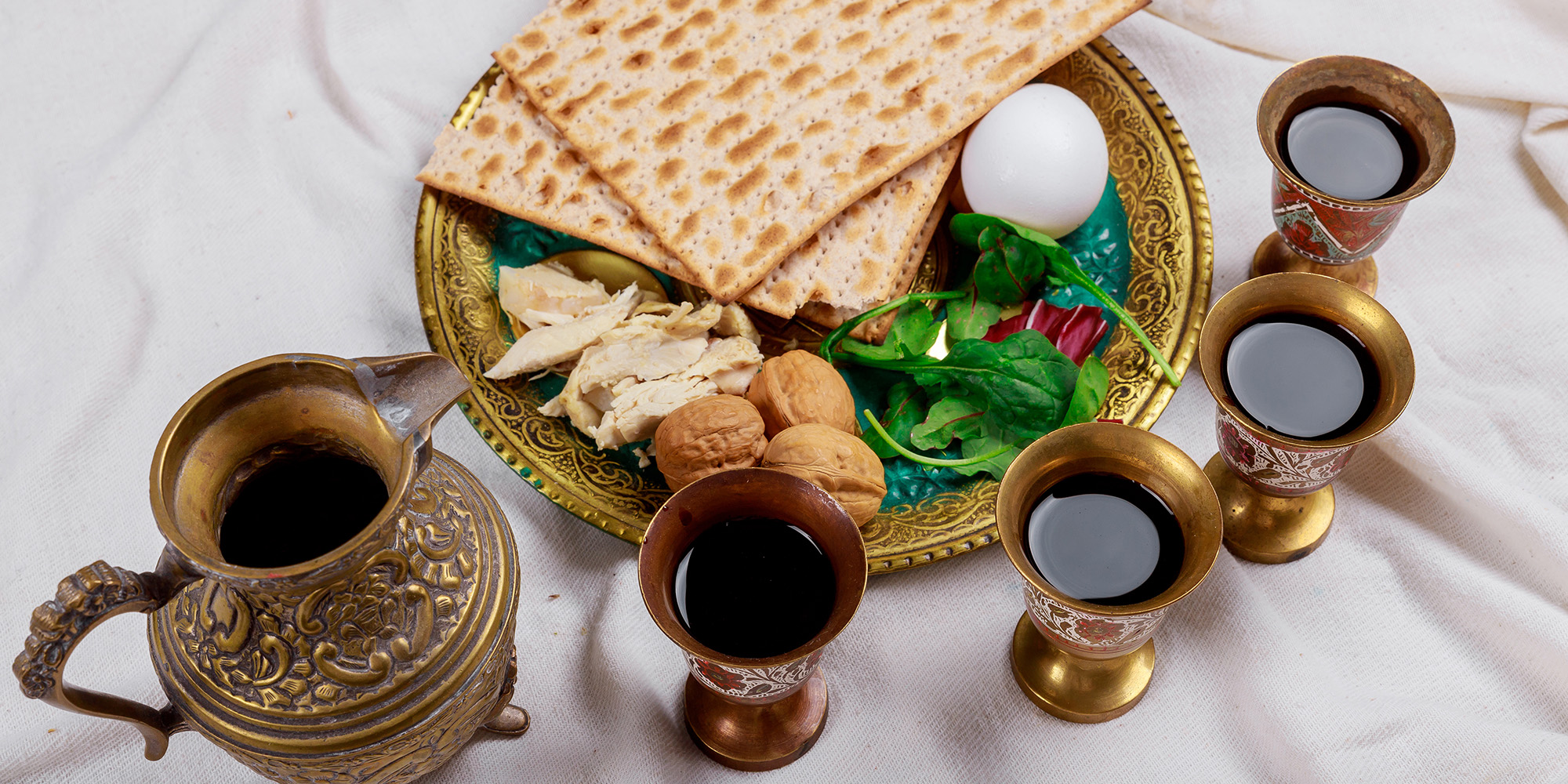
During the seder, the matzoh is placed in a bag called an echad, which means “one” . . . and this particular bag has three chambers. One piece of matzoh is placed into each. The piece placed in the first chamber is never touched, used, or seen. The second one is broken in half at the beginning of the Seder—half of the broken matzoh is placed back in the bag, and the other half, called the Afikomen, is placed in a linen cloth. The third piece in the bag is used to eat the elements on the Seder plate.
Interestingly, the word echad is used in Genesis 2:24, describing how husband and wife become one flesh. It’s also used in Numbers 13:23 when the spies returned from Canaan with a cluster of grapes. In both cases, echad refers to a complex unity of one. This is a powerful reference to the triune Godhead. The first matzoh that remains in the bag throughout the Seder represents God the Father, the unseen, invisible God (Colossians 1:15), while the third represents the Holy Spirit, of Whom we partake—the One who dwells within us. The second matzoh, the broken one, represents Jesus, the Son. As Jesus explained, the broken matzoh is a picture of His broken body (Luke 22:19). The half that is put back in the echad represents the divine nature of Christ while the half wrapped in a linen cloth—the one that is separated from the echad—represents His humanity.
The linen cloth symbolizes the burial cloth in which He was wrapped. During the Seder, this linen cloth with the matzoh inside is hidden. After the dinner, the children look for it. Once it is found, it’s actually held as a ransom. Wow! Christ, fully God, fully man, was broken for us. And He was buried (hidden), sought for, and resurrected. As the bread of life, His life was given as a ransom for many (Mark 10:45).
THE VEGETABLE (KARPAS)
This element—usually parsley—is dipped in salt water and eaten. The karpas symbolizes the hyssop branch that was used to spread the blood of the lamb to homes of the Israelites in Egypt. This is so amazing: In John 19:29, the hyssop was used to give Christ, our Passover Lamb, vinegar on the cross. The salt water it’s dipped in represents the tears shed during the bitter years of slavery and the sea that God parted during the exodus.
THE BITTER HERBS (MAROR)
The eating of “bitter herbs” comes from Exodus 12:8. It’s meant to remind the Jews of the bitterness of slavery. And while most of us may not be able to relate to being subjected to physical slavery, we can all relate to the subjugation of spiritual bondage to sin.
THE CHAROSET (HAROSETH)
Charoset is a mixture of apples, nuts, wine, and spices, which represents the mortar used by the Israelites to build Egyptian structures during their bondage. Interestingly, this is the only sweet element in the entire Seder and is intended as a reminder of the hope of redemption . . . a hope that is fulfilled completely and only in Jesus Christ.
THE EGG (BAYTZAH)
Traditionally, the hard-boiled egg symbolized sacrifice made in the days of the temple. Since the destruction of the temple, it’s become symbolic of the loss of the two temples, and hence, is consumed as a food of mourning. For the believer, we can view the egg as the sacrifice laid down at the altar of eternity.
THE FOUR CUPS
The first is known as the cup of sanctification, the second is the cup of judgment, the third is the cup of redemption, and the fourth is the cup of praise. At the Last Supper, Jesus took the first cup and promised His disciples that the next time He drank the fruit of the vine with them would be in the kingdom (Luke 22:17). Later in the Seder, Christ used the cup of redemption to illustrate the New Covenant in His blood (Luke 22:20), the blood that would be spilled for our redemption!
So, whether you have a Passover Seder at home this year, watch one online, or even as you read the story of the Last Supper, consider how beautifully His story as our Passover Lamb was woven through this powerful celebration.